 EveryDaySys
$9.99$19.99
Buy now →EveryDaySys
A spreadsheet for the desk, an app for the market stall, and a reseller workbook for the sourcing trips. Buy the bundle and you stop deciding which one you need.
There's the desk work — what you have, what it cost, what you sold it for. Then there's the stall: standing in a field, no signal, somebody handing you a tenner. And there's the sourcing: driving to a lot, paying for fuel, wondering whether the trip paid for itself.
One spreadsheet can't do all three well. A cloud app fails the second one outright. And most sellers end up doing all three badly, in their head, at night.
So this is three tools instead of one compromise. A 12-tab spreadsheet, a 13-tab reseller workbook, and an 11-screen offline app — bundled at less than the price of two.
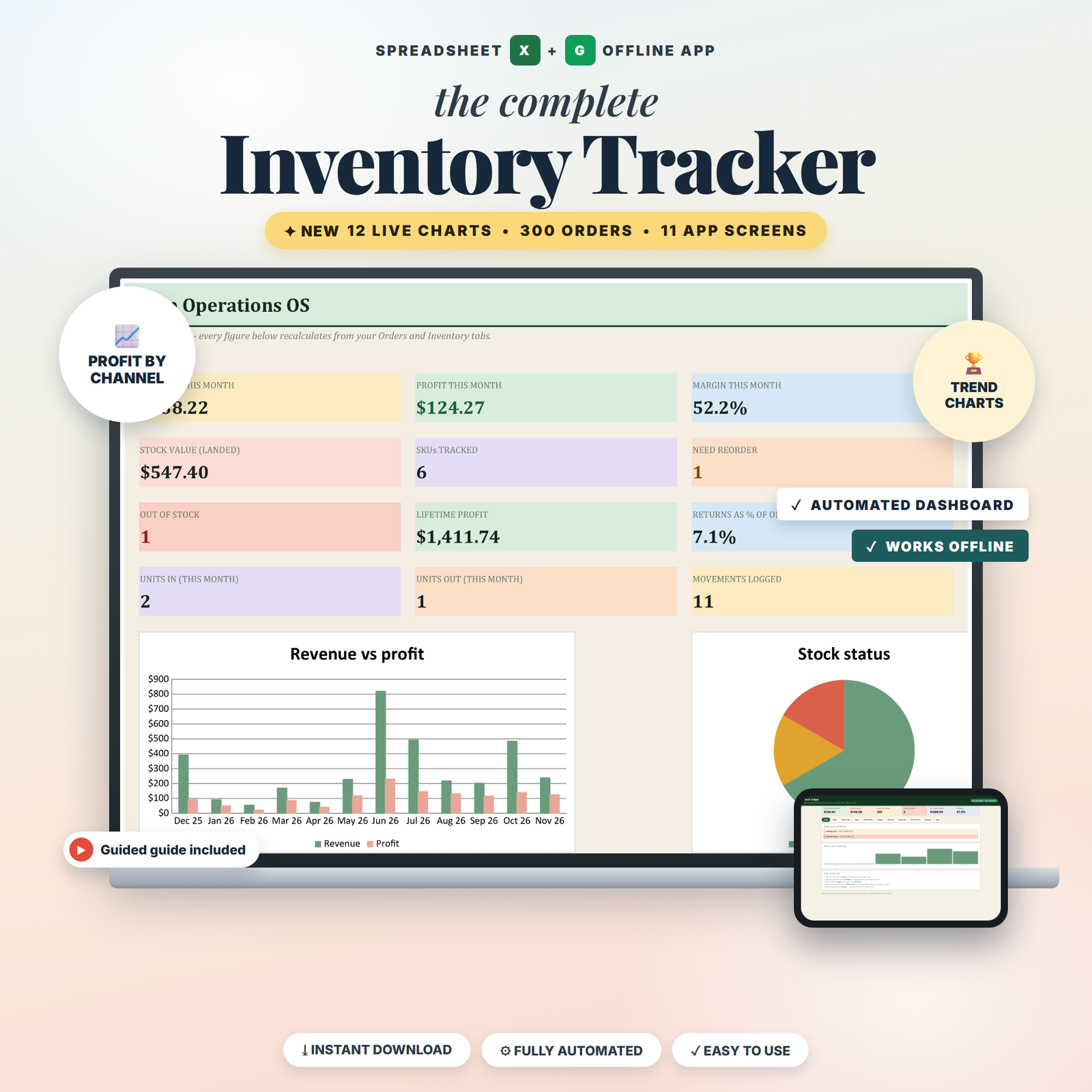
Shop Operations OS is the daily driver: inventory, orders, profit, returns, suppliers, purchases, a movements ledger and six charts that redraw as you type.
Reseller Profit Tracker adds the thing almost nobody tracks — what it cost you to go and get the stock, spread across every unit you brought home.
Stock Ledger is a single HTML file: eleven screens, opens in your browser, works with the wifi off. That's the one you use standing at a table.
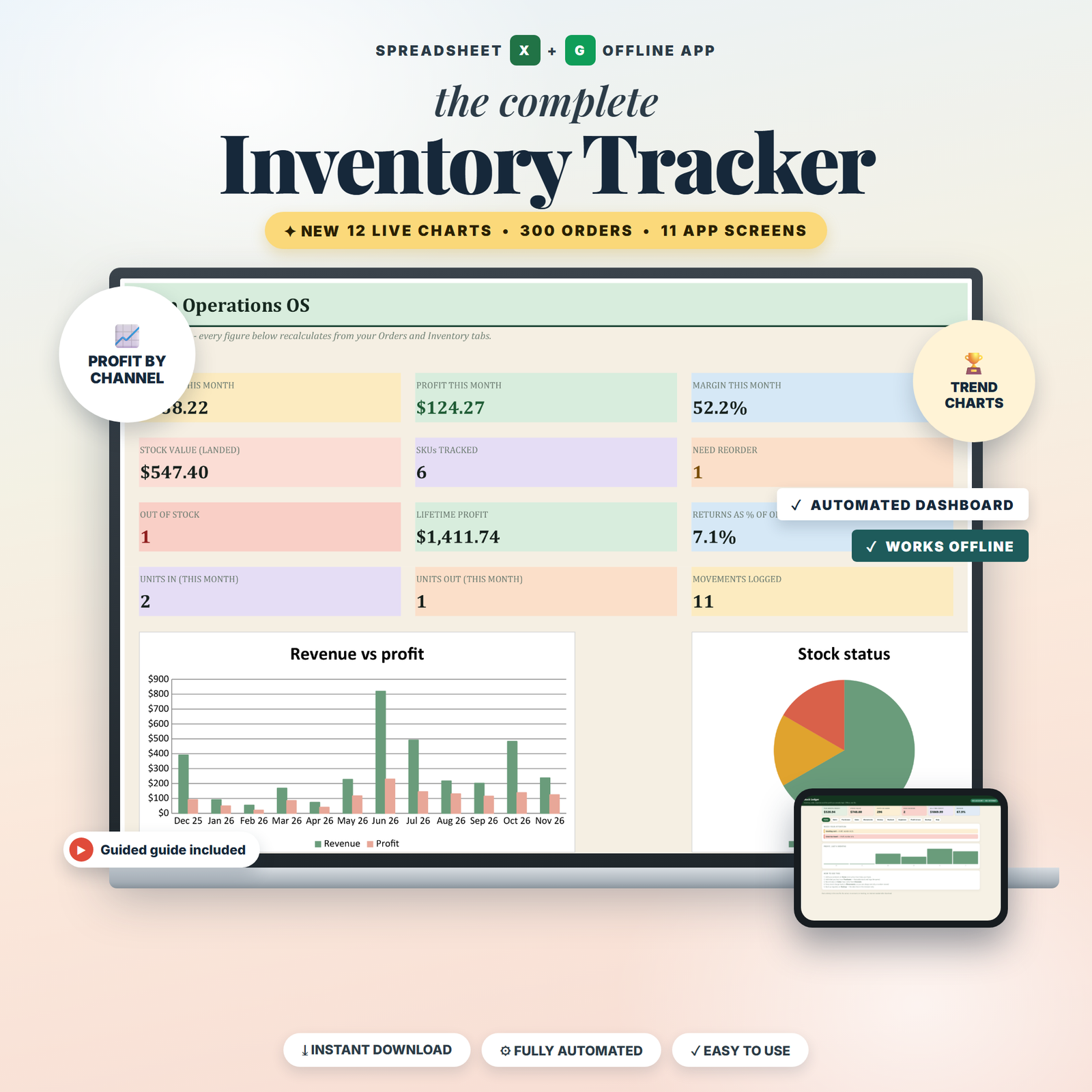
No setup wizard, no blank canvas, no tutorial to watch. The workbook ships with sample data so you can see it working before you touch it — then you delete the rows marked EXAMPLE ROW and type your own.
Add your items once: what it cost you landed, what you charge, how many you have, and the level where you want a warning. Everything else reads from that.
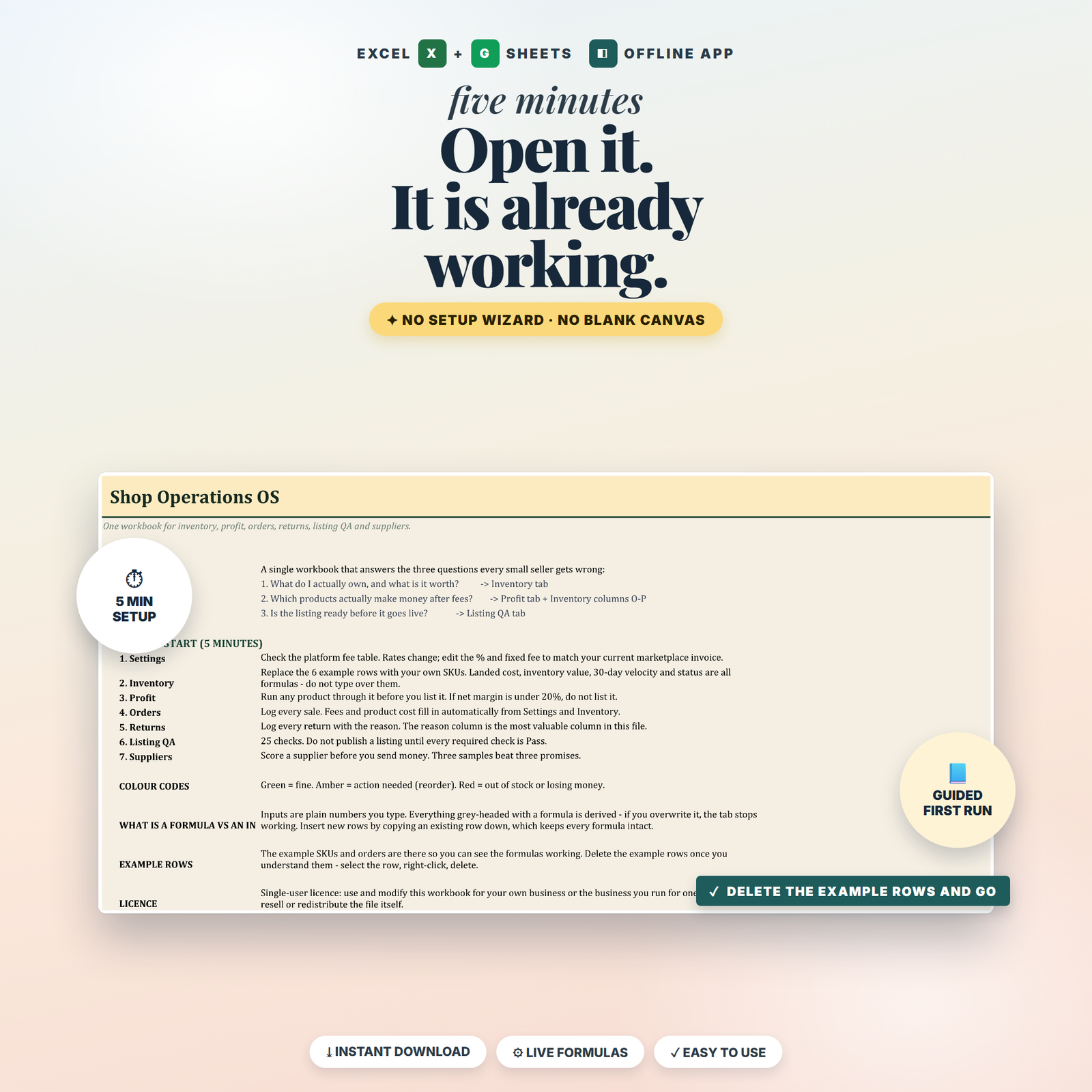
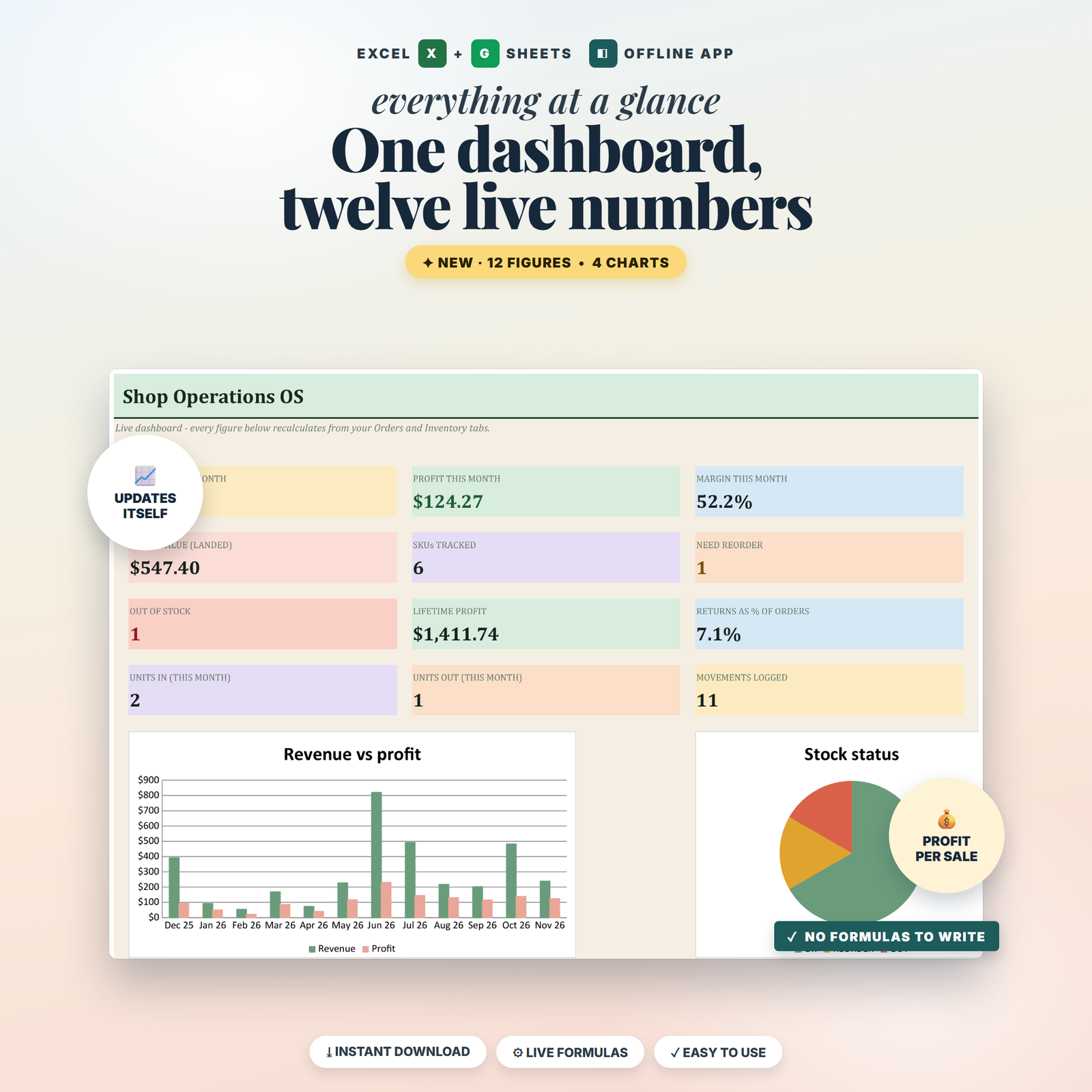
Twelve figures across the top: revenue, profit, margin, stock value, units, reorder count, out of stock, lifetime profit, returns and movements logged. Below them, four charts.
None of it needs a pivot table. Log an order and every number recalculates — including the restock list, which knows what you've sold and what you still owe.
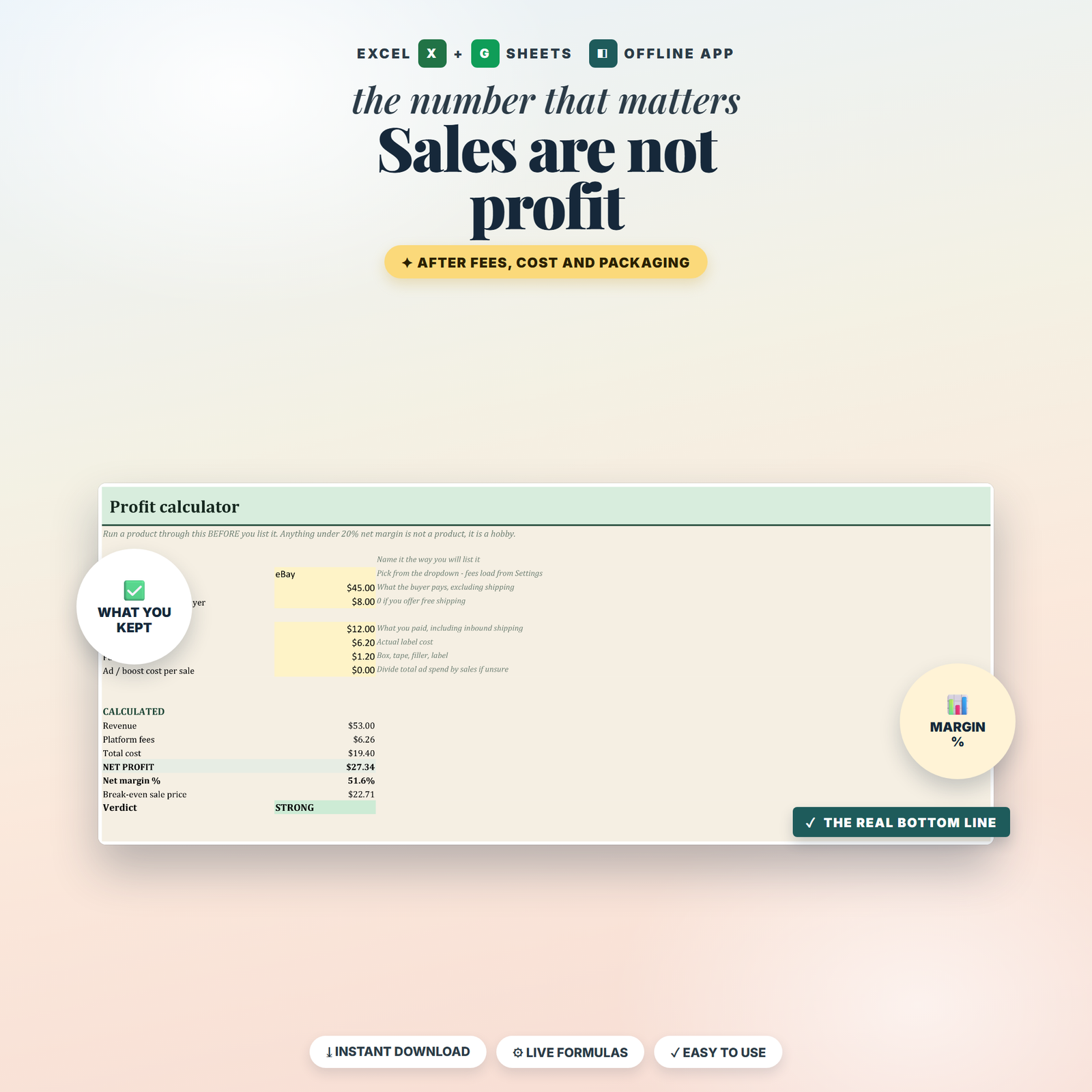
Revenue is the number that makes you feel good. Profit is the one that pays you. This tab separates them: fees, cost, packaging, and what's left.
The chart beside it is the one that changes behaviour — fees and costs stacked against profit, so you can see how much of a $30 sale was ever yours.
Drop your price 20% and profit doesn't fall 20%. It usually falls closer to 40%. Seeing that in a chart is worth more than reading it in a blog post.
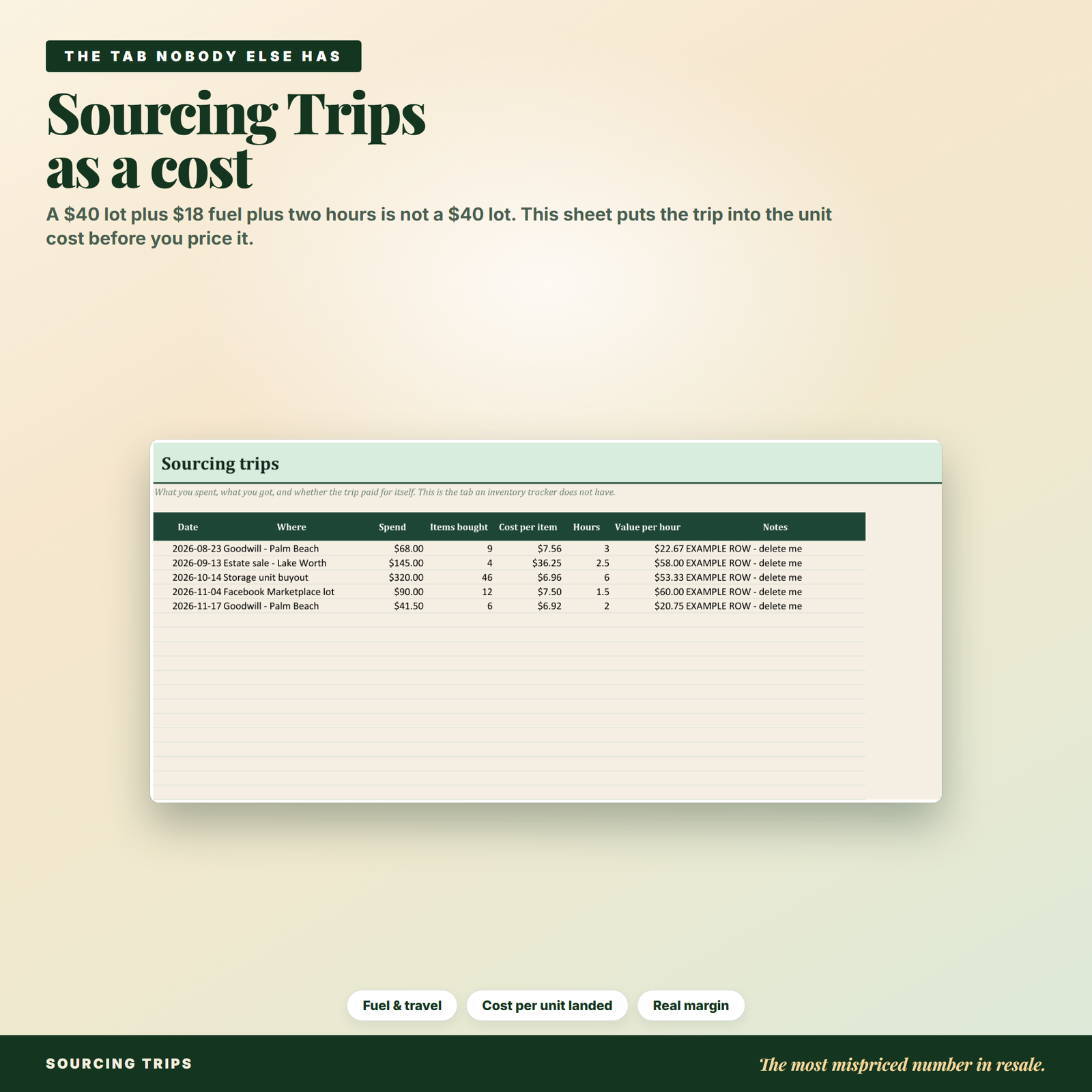
This is the difference between a reseller who knows their numbers and one who's guessing. Log a trip — what you paid for the lot, the fuel, the parking — and it spreads across every unit you brought back.
A $40 lot of 20 items isn't $2 a unit. It's $2.90. Every profit figure in the workbook uses that number, not the sticker price on the tag.
The lots that look best at auction are regularly the worst per unit. You only find that out if the trip is in the maths.
Cloud trackers are wonderful until you're in a field with one bar of signal and a queue forming. Then it's a receipt and a promise to enter it later.
Stock Ledger is a single HTML file. Double-click it, it opens like a web page, and it keeps working when the internet doesn't. Nothing is uploaded, so nothing can be lost in a field.
Record a sale and the stock comes off automatically, with the channel fee already subtracted from the profit.
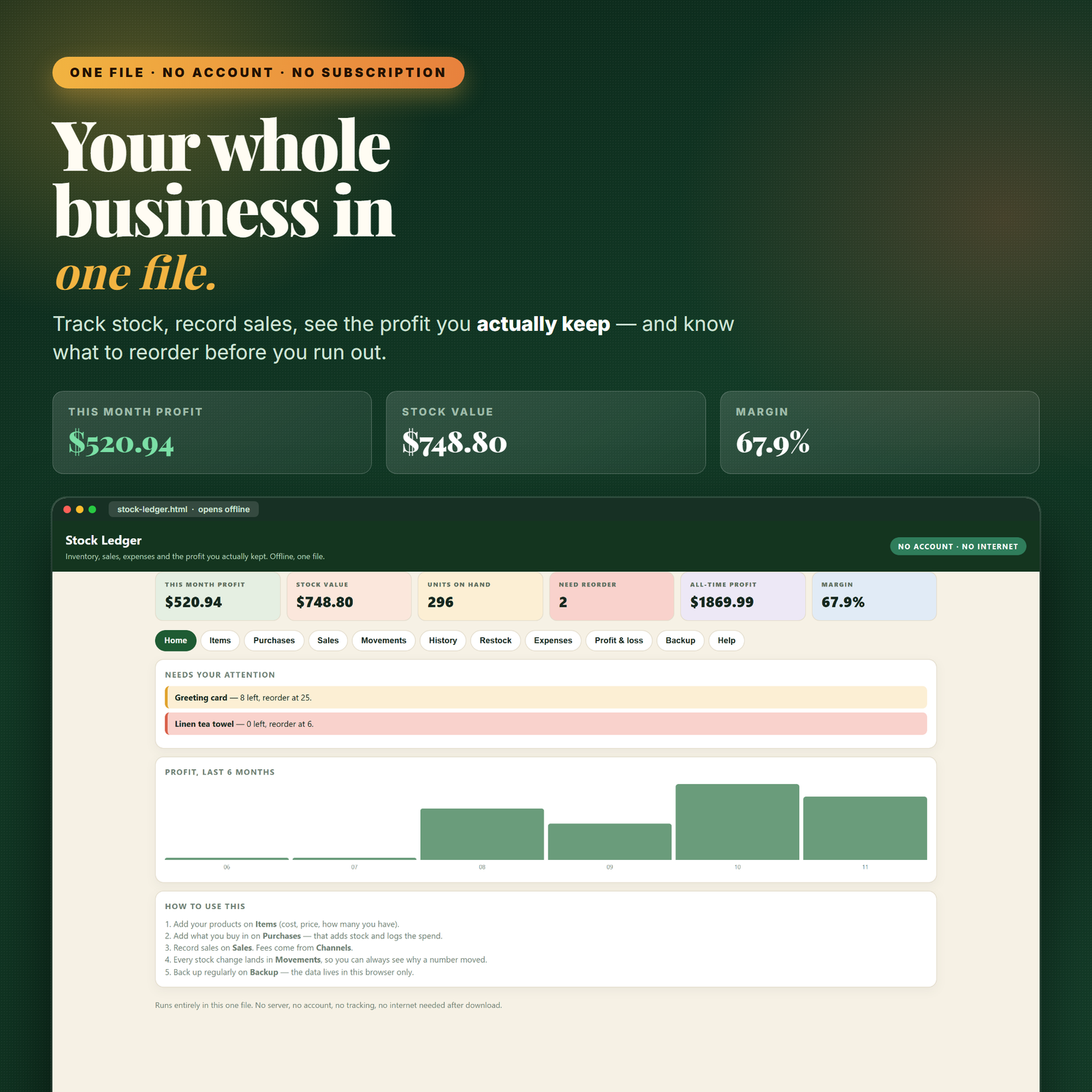
Sell more than you have and the app lets it go negative. Three sold with none on the shelf reads −3, flags red, and puts three more on the shopping list. That's deliberate: you owe somebody product, and hiding it at zero only means finding out from a complaint.
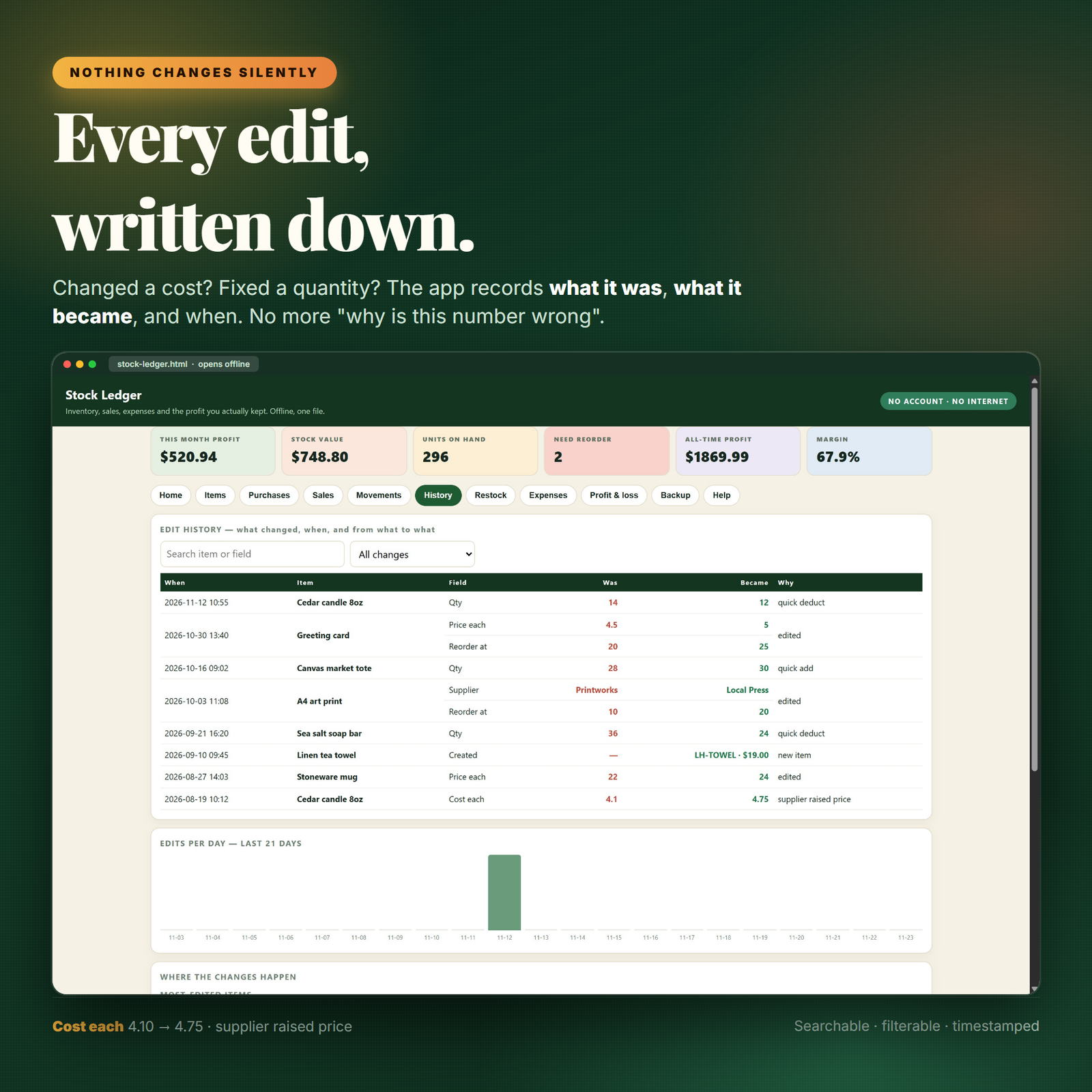
Change a cost, fix a count, correct a sale — every edit is written down with a timestamp and the before/after. When a number looks wrong, the answer is one tab away.
One zip containing two .xlsx workbooks and one .html app, plus a read-me. Unzip, open the spreadsheets, double-click the app.
Yes — as many of your own machines as you like. The files are yours.
No. You pay once. There is no account, no login and no renewal.
No. The formulas are already written. You type numbers into white cells; grey cells calculate themselves.
Each is sold separately at $5.99. The bundle is $9.99, so the third file costs a dollar.
Three files, one price, and the numbers stop lying to you.
Buy now — $9.99 →