SellersMath
The answer
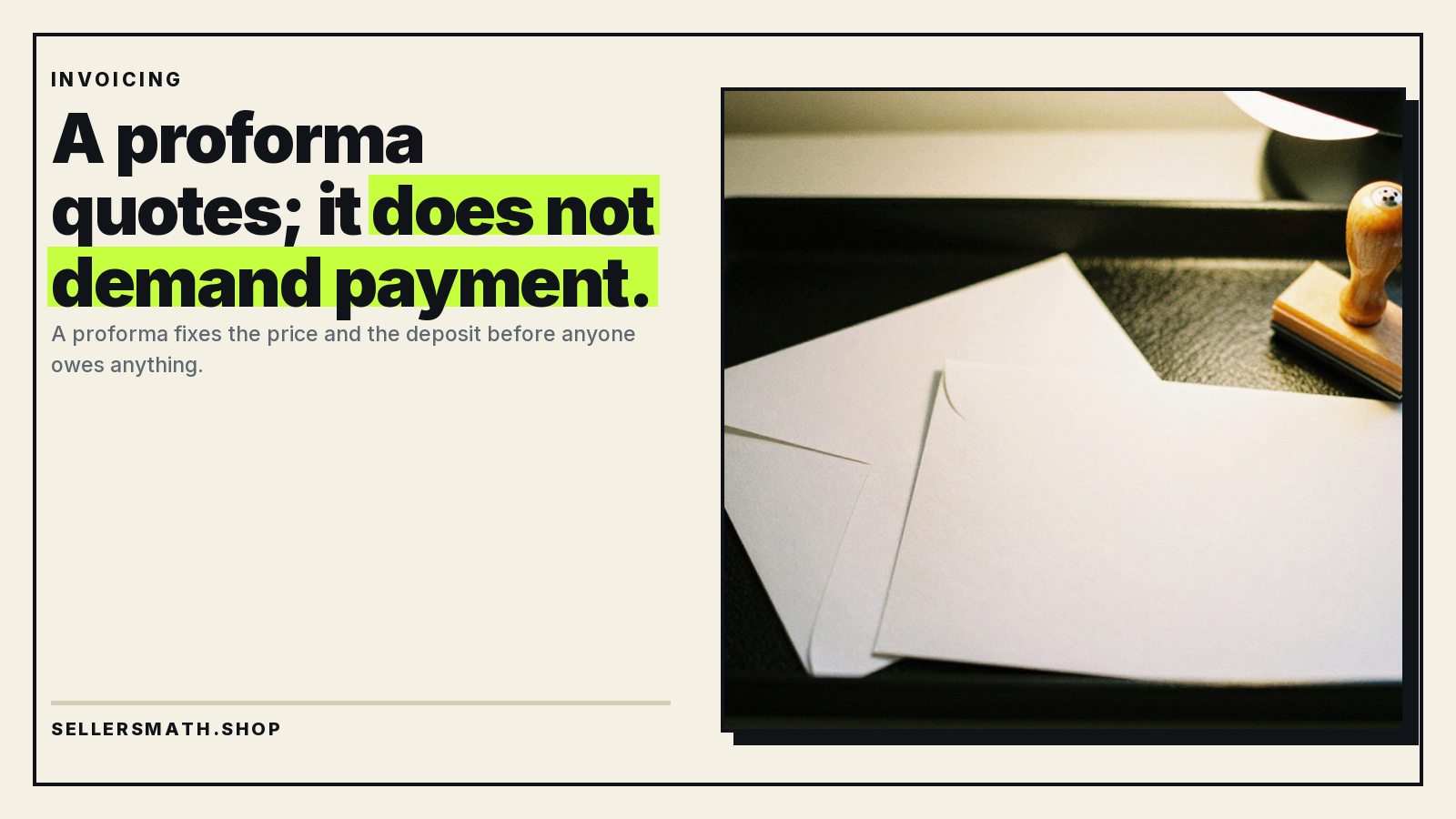
A proforma is the document you send when the price has to be agreed and the work has not started. It carries a total that the eventual invoice must match, not a demand for payment. On the worked order here the proforma totals $4,470, a 30% deposit is $1,341, and $3,129 is left for the real invoice.
The arithmetic
Three units at $1,450 come to $4,350 before anything else. Shipping adds $120, so the proforma total is $4,470 with no tax on it. Take 30% of that total: $4,470 × 0.30 = $1,341. Subtract the deposit and the balance that will fall due on the actual invoice is $4,470 − $1,341 = $3,129.
Call the document what it is, on the first line, and number it in a separate series.
That $4,470 is a promise, and it is the number that has to survive until the invoice goes out. If the customer agrees to the proforma and you later invoice $4,620 because the shipping quote moved, you have re-opened a price you thought was closed. The fix is not a sterner letter; it is a validity date on the proforma and a new proforma when the number moves. Tax is left at zero above on purpose, because the rate belongs to your jurisdiction and not to this page. Put your own rate in and the same two steps hold: the total rises, the deposit is still 30% of it, and the balance is still whatever is left.
The three mistakes
The first is writing “invoice” in the title. A proforma titled invoice enters the customer’s accounts payable as a bill, and if they pay it before you have supplied anything you are now holding money against a supply that has not happened, which is a tax question in most jurisdictions and an awkward one everywhere. Call the document what it is, on the first line, and number it in a separate series.
The second is showing no validity date. A proforma with no expiry is an offer to hold a price forever, and suppliers who quote in materials-heavy trades know exactly how that ends. Ten days or thirty, printed, is enough.
The third is taking the deposit off the proforma total without recording what it was against. When the invoice comes, the deposit has to appear as a credited line, not disappear from the total. If the customer’s bookkeeper cannot see $1,341 credited on the invoice, the invoice reads as a request for the full amount and you spend a week proving otherwise.
What the document must carry
The word proforma in the title. A proforma number from its own series, so it never collides with an invoice number. Both addresses, the date, and a validity date. Each line with quantity, unit price and amount. The deposit percentage and its cash amount. What the deposit is against, and whether it is refundable. The words “not a demand for payment” somewhere a reader will hit them. What is excluded: freight, installation, duty, whatever you are not covering. Everything on that list is a field in the proforma invoice generator, which prints the document in the browser and stores nothing.
When the deposit is agreed, the next job is deciding what the rest of the schedule looks like, and that is a different piece of arithmetic: splitting the balance into a deposit plus milestones.
When this doesn’t apply
If a purchase order already fixes the price, a proforma is paperwork that adds a step and no information. If the sale is going through a letter of credit or a customs entry, the bank or the broker owns the format and you should fill in their document rather than a nicer one. And where a deposit is taxable on receipt, the proforma is not the document that reports it; the receipt or the tax invoice is. Keep the proforma for the price, and let the paperwork that reports money do its own job. Once the customer has the proforma they can print from, the offline invoice builder turns the same figures into the invoice that actually asks to be paid.