SellersMath
The answer
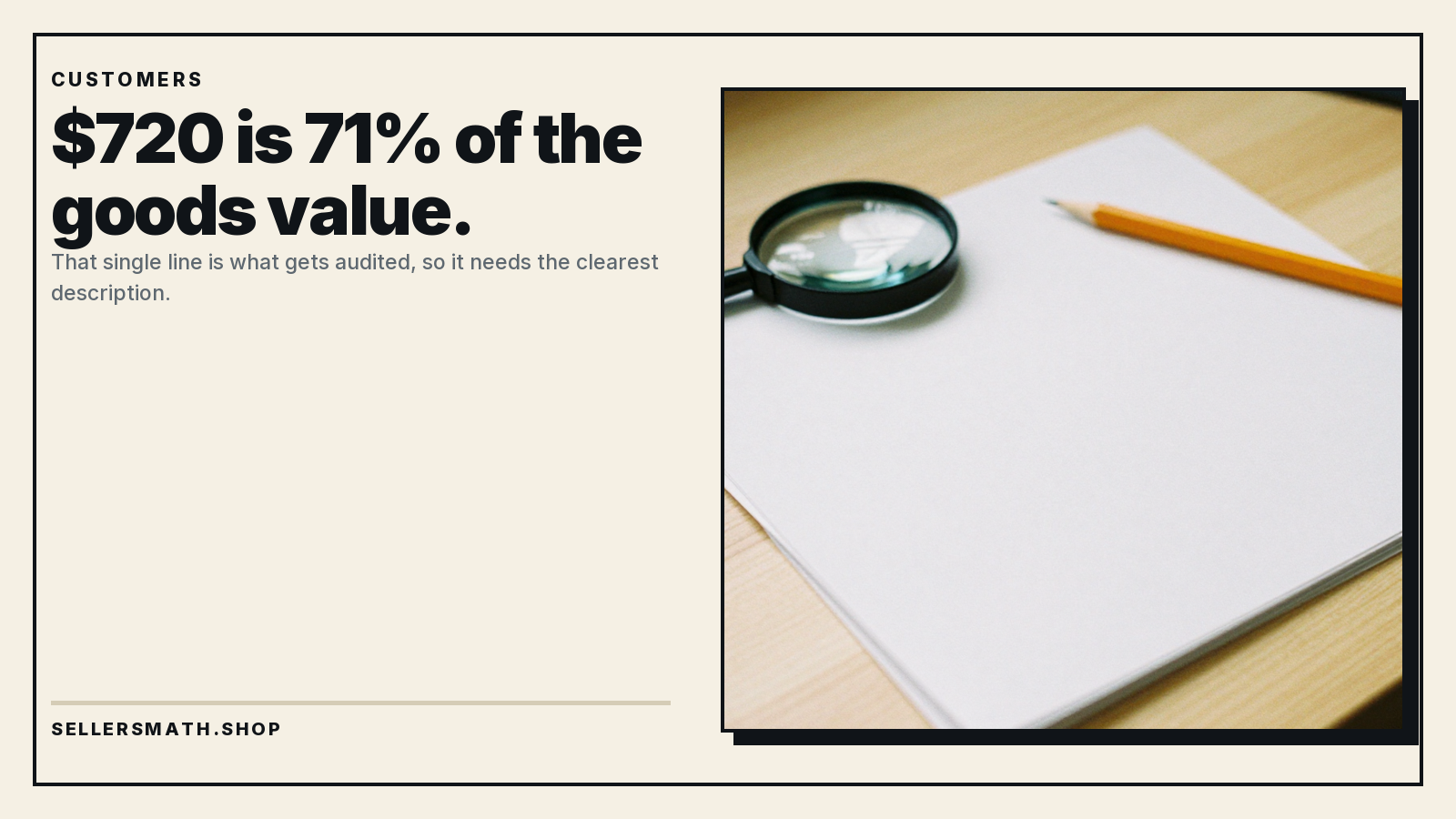
Put a quantity and a unit price on every line, and give the biggest line the longest description. Three lines come to $1,014 here and the largest is $720, which is 71.0% of the goods value. A customer who cannot check that line in one glance will question the whole invoice.
The arithmetic
Line one: 3 units at $240 is $720. Line two: 1 at $180 is $180. Line three: 12 at $9.50 is $114. Add them: $720 + $180 + $114 = $1,014, which is the invoice total with no discount, delivery or tax on it.
The average line is $1,014 ÷ 3 = $338, and the largest is $720. Both numbers are on the invoice as soon as the lines are, and they are what a customer uses to decide where to look. A line of $720 that reads “materials” invites the question; a line that reads “3 × oak shelf, 1.8m, cut and finished, $240 each” answers it before it is asked.
Two of these three lines are checkable in a second: twelve at $9.50 is $114 and anyone can see it.
Now the version that gets paid late. The same job invoiced as one line, “materials and labour, $1,014”, is arithmetically identical and financially different. Nothing on it can be checked, so the customer’s bookkeeper either pays it (if they trust you) or sends it back with a question (if they do not, or if they are being audited). The invoice has not become wrong; it has become unverifiable, and unverifiable invoices wait at the bottom of the pile.
Two of these three lines are checkable in a second: twelve at $9.50 is $114 and anyone can see it. The $720 line is the invoice’s centre of gravity, and the average line of $338 tells you the same thing from the other side: this is not a bill where the detail is decorative, it is a bill where two lines carry 89% of the money. Describe those two properly and the invoice stops being a question.
The three mistakes
The first is the summary line. One total is a price, not a bill, and a price has to be renegotiated while a bill only has to be checked.
The second is hiding unit prices so that quantity × rate cannot be verified. If you have a reason to quote a bundle price, say so and show the bundle’s contents; do not show a rate that does not multiply out.
The third is a line with no reference. The largest line should point at something the customer already has, a quote number, a purchase order, an approval email. That reference is what turns a query into a lookup.
What the document must carry
One line per thing, with description, quantity, unit price and amount. A total that is the column’s sum, not a rounded version of it. Discount, delivery and tax as their own lines with their own bases. A reference per line where a document exists. The itemised invoice generator keeps the columns in that order and prints the largest line’s share of the total, which is the number that tells you whether the invoice is checkable or merely correct.
When a line turns out to be wrong after the invoice has gone, the correction has a document of its own: a credit note that reverses the line without rewriting the invoice.
When this doesn’t apply
On a single-product sale the itemisation is the product name and a quantity, and there is nothing to split. Where a client’s procurement requires a summary invoice with a schedule attached, put the schedule behind the summary rather than replacing it. And on work sold as an outcome, a fixed price is the honest document: an itemised bill for a package price invites the client to start removing items.
Itemising is a pricing decision before it is a formatting one, which is why it belongs with the quote as well as the invoice: the same lines, in a spreadsheet you can total.