SellersMath
The answer
Declare the customs value, not the amount you charged. On CIF terms it is goods plus freight plus insurance: $4,625 on a $4,200 order. Duty at 4.7% is $217.38, import tax at 20% is $968.48, and the total the invoice declares is $5,810.86.
The arithmetic
Start with goods: $4,200. Freight is $380 and insurance $45, so the customs value, which is the base the duty is charged on, is $4,200 + $380 + $45 = $4,625.
Duty is 4.7% of that base: $4,625 × 0.047 = $217.375, which is $217.38 at two decimals. Import tax is charged on the value plus the duty, not on the value alone: $4,625 + $217.38 = $4,842.38, and 20% of that is $968.476, or $968.48. Add it all back together and the invoice declares $4,625 + $217.38 + $968.48 = $5,810.86.
The 28.2% figure is the one to keep for the customer conversation.
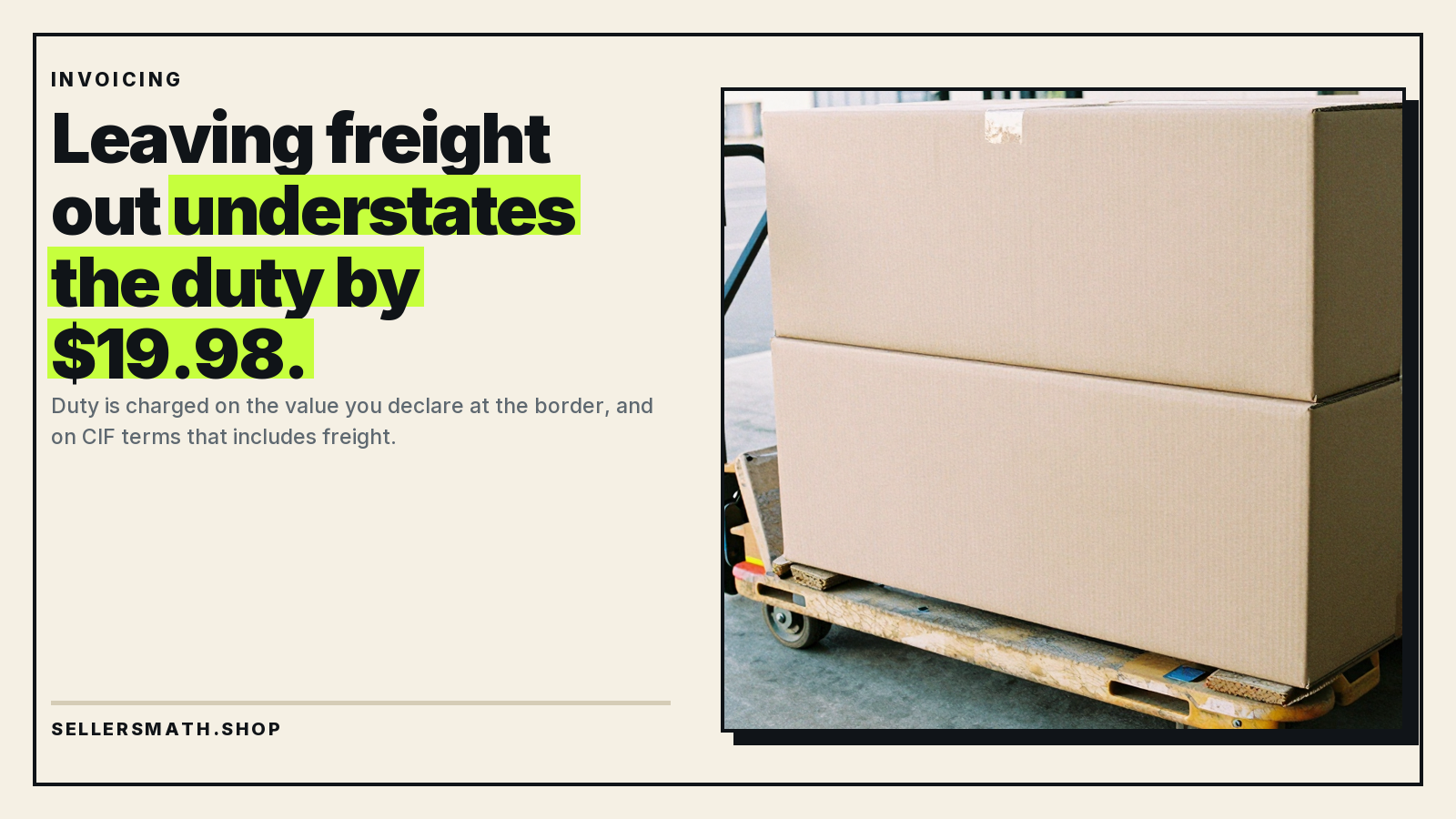
Now do the same sum on FOB terms, where freight and insurance sit outside the base. Duty becomes $4,200 × 0.047 = $197.40, which is $19.98 less than before. Import tax becomes 20% of $4,200 + $197.40 = $879.48, which is $89.00 less. Declaring FOB does not save the customer money; it moves $108.98 of the bill to whoever is the importer of record, and if that is you, the difference lands on your account with a broker’s fee on top.
The 28.2% figure is the one to keep for the customer conversation. Duty and import tax together are $1,185.86 on a $4,200 order, so the landed cost of the goods is nearly a third higher than the price you quoted before anyone has moved them. That is not a hidden fee and it is not your margin: it is the border, and it belongs in the quote as its own line so the customer is not surprised by it on the day the container clears.
The three mistakes
The first is copying the sales invoice total onto the customs document. Your invoice total may include your margin, your packaging, or a discount that the border does not recognise; none of those is the declared value.
The second is picking the Incoterm after the price was agreed. FOB, CIF and DDP change who pays the duty and what the base is. Put the three letters and the named place on the invoice, because a bare “CIF” is not an answer to a broker’s question.
The third is guessing the HS code. The duty rate depends on it, and a code that is one heading off is a rate that is wrong in a way nobody notices until the entry is filed. Ask the broker for the code before the first shipment, then keep it on the invoice from then on.
What the document must carry
Each line with a description clear enough for a customs officer, the HS code, the country of origin, quantity, unit value and line total. The currency. The Incoterm and the named place. Net and gross weight. The reason for export. The seller and the buyer with addresses and tax identifiers. The commercial invoice generator puts the customs value, the duty and the import tax in separate lines so the broker can follow the base from goods to total without an email.
The domestic version of the same document is a different animal, and it is worth seeing the difference once: what a sales invoice has to add up to.
When this doesn’t apply
Below the de minimis threshold of the destination country there may be no duty at all, and the invoice is then a record rather than a tax base. Some goods, and some destinations, need certificates or licences that no invoice can substitute for. And the commercial invoice is not the customs declaration: a broker files the entry, and your job is to give them a document that agrees with itself.
What the invoice cannot fix is a price that was never quoted properly. If the goods line is wrong before it reaches the border, the Word invoice template is the editable version most buyers ask for while the numbers are still moving.